
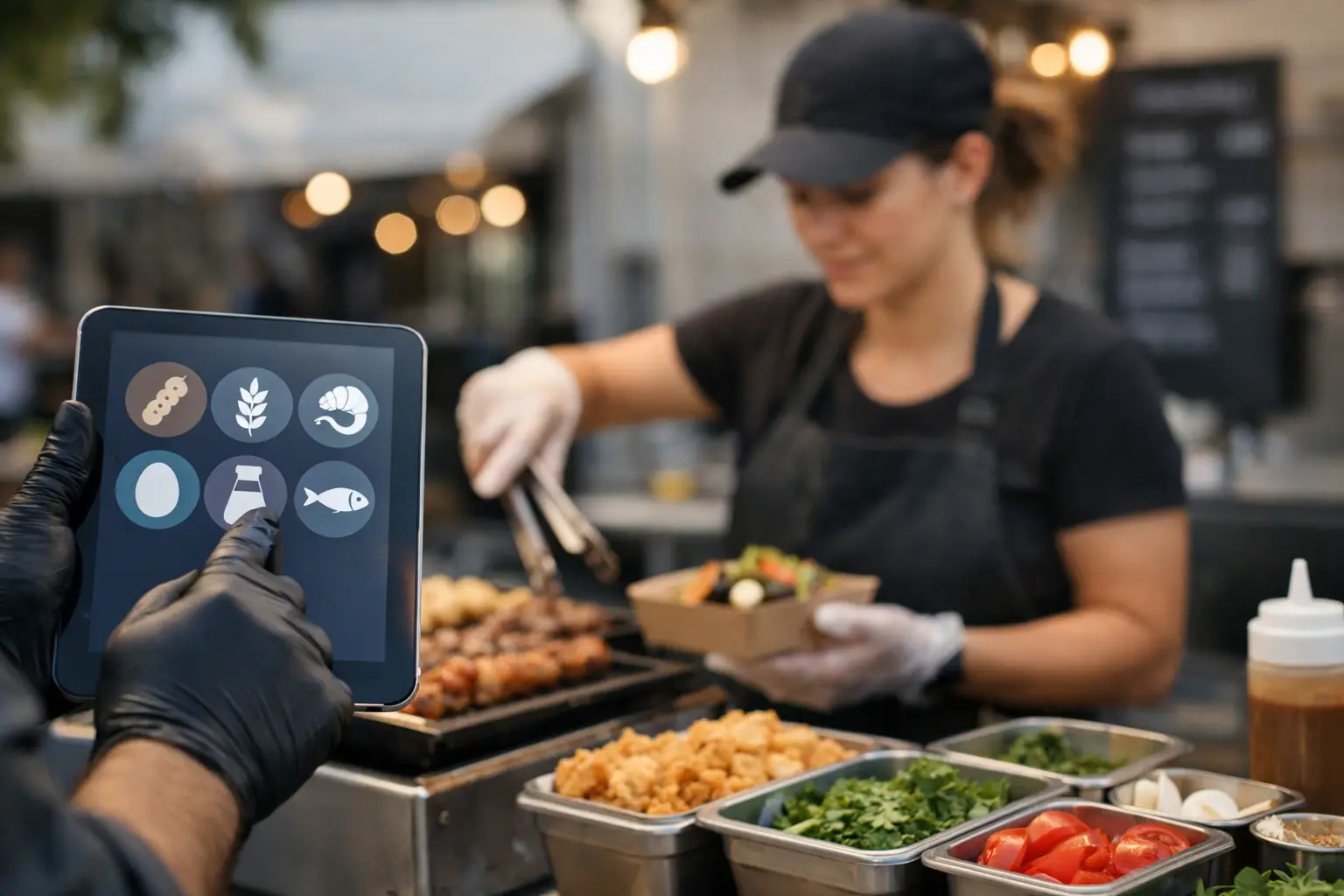
A customer at your stall asks whether the satay chicken contains peanuts. The queue is growing, the fryer is running, and your newest casual is taking orders. Allergen tracking for food stalls is what turns that moment from a risky guess into a clear, confident answer.
For mobile food operators, allergen control is not just a menu-writing task. Ingredients change, prep happens in tight spaces, and the same utensils, fryers and hands can move between products all service long. A practical tracking process helps protect customers, gives staff a dependable source of truth and keeps your stall ready for the questions that matter most.
Why allergen tracking gets harder at a stall
A restaurant kitchen may have fixed storage, a consistent team and time to check a recipe folder. A market stall often has the opposite: a compact marquee, a rotating crew, ingredient deliveries in the back of a ute and a lunch rush that starts before everyone has settled in.
The risk is not limited to a dish that obviously contains an allergen. It can sit in a bottled sauce, spice blend, garnish, stock powder or pre-made pastry. It can also come from cross-contact, such as gluten-free chips cooked in oil shared with crumbed products, or a dairy-free drink made with a blender that has not been properly cleaned after a milk-based order.
Australian food businesses need to provide accurate allergen information when customers ask. The exact obligations and enforcement approach can vary by state, territory and council, so operators should confirm the rules that apply to their business. Operationally, though, the standard is straightforward: never make a claim your team cannot support with current ingredient and preparation information.
Build one source of truth for every menu item
The strongest allergen tracking for food stalls starts before event day. Create a record for every item you sell, including drinks, sides, sauces, toppings and specials. Do not rely on memory, a handwritten sign from last season or a staff member who “usually knows”.
Each record should show the recipe version, supplier and date last checked, then identify whether it contains any of the major allergens relevant to your menu. In Australia, the priority allergens include peanuts, tree nuts, milk, egg, sesame, soy, fish, crustacea, molluscs, lupin, gluten-containing cereals and added sulphites at specified levels.
A useful item record also needs to separate three different answers. First, what the food deliberately contains. Second, what may be present because of a supplier warning or shared production environment. Third, what cross-contact risk exists in your own stall setup. Those distinctions matter. A customer managing coeliac disease needs more than a broad statement that a product is “gluten friendly”.
For each product, record:
- the current ingredient list and supplier product name
- allergens intentionally included in the recipe
- supplier precautionary statements, such as “may contain” warnings
- preparation and cooking equipment used
- substitutions allowed and substitutions never allowed
- a clear customer-facing answer for staff to use
Review this record whenever a supplier, recipe, pack size or garnish changes. A new mayonnaise brand or different tortilla supplier can change the answer to a customer’s question, even when the menu name stays the same.
Keep supplier information with the stall, not back at home
Save current product labels and specification sheets in a format your team can access at the event. A printed allergen folder works well for a simple stall. A digital record is faster to search and easier to update across multiple team members, provided it remains available when reception is patchy.
The key is version control. If an old ingredients spreadsheet and a new supplier label disagree, the current label wins until you have checked the recipe. Remove superseded printouts. Outdated information creates the same problem as no information at all.
Turn records into a service-day workflow
Information only protects customers when it changes what happens at the counter and in the prep area. Start each event with a short allergen briefing. It can take five minutes, but it should cover new ingredients, sold-out substitutions, designated equipment and who has authority to answer customer questions.
Staff need a simple rule: if they are unsure, they do not guess. They pause the order and check the record or ask the manager. A brief delay is far better than an incorrect reassurance.
When a customer discloses an allergy, repeat it back and confirm the item they are considering. Then check both the ingredients and the preparation process. “No nuts in the sauce” is not enough if the dish is assembled on a bench covered with nut topping from the previous order.
Use a clear order marker, whether that is an allergen ticket, a prominently marked POS note or a verbal call-and-response system. The cook should acknowledge the request before making the item. During a peak period, assign one person to handle allergen queries rather than leaving every team member to interpret labels while taking payment.
If your process cannot safely accommodate the request, say so plainly. It may feel like a lost sale, but it is the responsible choice. “We cannot guarantee this is safe for your allergy because our fryer is shared” is clear, respectful and more useful than a vague assurance.
Control cross-contact in a small footprint
Food stalls rarely have the luxury of a separate allergy kitchen. That does not mean every request is impossible. It means you need honest boundaries and controls that suit the site.
Where practical, use dedicated utensils, squeeze bottles and storage tubs for allergen-sensitive products. Keep loose toppings covered and separated. Prepare allergy-aware orders first where this reduces exposure, and clean benches and equipment between tasks using a method that actually removes food residue rather than simply wiping it around.
Shared oil deserves special attention. Fryers are efficient, but they can transfer proteins and gluten-containing crumbs between foods. If you use one fryer for everything, document that risk and train staff not to represent fried items as allergen-free. The same applies to sandwich presses, grills, blenders, ice-cream scoops and tongs.
Labels should help the crew work quickly. Colour-coded containers can be useful, but only if everyone understands the system and the labels name the actual contents. A red lid is not a food-safety control on its own. Clear wording, clean equipment and consistent handling are what make the difference.
Make menu communication useful, not overconfident
A menu can flag common allergens, but it should not be your only control. Small print is easily missed, specials boards change often and customers may need information that is more specific than an icon can provide.
Avoid broad claims such as “allergen free” unless you have the evidence and controls to support them. Even “vegan” does not automatically mean safe for someone with a milk or egg allergy, and “gluten-free” needs careful handling where shared equipment or ingredients are involved.
Instead, make it easy for customers to ask. A short prompt such as “Ask our team about allergens and ingredients” is practical when backed by trained staff and current records. For vendors with online menus or pre-ordering, carry the same product data through to digital listings. Customers should not receive a different answer online than they do at the counter.
Give organisers visibility without creating paperwork overload
Organisers have a role in safer event food operations too. Vendor applications can ask food stalls to confirm food registration details, provide an allergen management approach and identify high-risk preparation methods such as shared frying or on-site cooking. That is not about turning a market organiser into a food inspector. It is about identifying operational needs early.
At the event, organisers can support vendors with practical site decisions: adequate handwashing access, clean water, waste collection, power that will not fail mid-service, enough spacing between cooking stalls and a clear process for incidents. A site plan that places a nut-heavy dessert vendor directly against an open prep bench may be workable, but it deserves thought.
An integrated event operations platform such as Evntle can help organisers keep vendor records, site details and event-day communication in one place. The benefit is not more administration for its own sake. It is fewer disconnected messages when a vendor changes a menu, needs a site adjustment or raises a safety issue before gates open.
Review after each event
The best tracking system improves through use. After pack-down, note any allergen questions that stalled service, ingredients staff struggled to identify, customer requests you could not safely meet and near-misses caused by substitutions or unclear labels.
Then fix the process before the next market. Update the product record, change the prep sequence, replace ambiguous wording or train the team on the exact scenario. Food stalls grow through repeat customers, and trust is built when people can see that your operation takes their needs seriously.
A clear answer at the counter is not merely good service. It is the result of organised ingredients, confident staff and a stall setup designed to do the right thing when the queue is at its longest.
📖 Related
See the KDS and POS in action — try the live demo or create a free account.