
Arts and Crafts POS: A Practical Guide for Australian Stallholders
An arts and crafts POS is a point-of-sale system built for handmade, one-off and small-batch products — it handles variable pricing, unique SKUs, cash and card payments, and works on a phone, tablet or desktop at a market stall. For Australian makers, the best arts and crafts POS combines fast checkout, offline mode, stock control, and a vendor storefront so event-day sales turn into repeat customers. This guide breaks down what to look for, what it costs, and how to run it smoothly at craft fairs, farmers markets and festivals.
If you sell jewellery, ceramics, candles, prints or textiles, you already know the drill: every item is a little different, customers want to chat, and the queue builds fast at 10am. A generic retail till won't cut it. You need something that moves as quickly as your ideas do.
What Is an Arts and Crafts POS and Why Does It Matter for Makers?
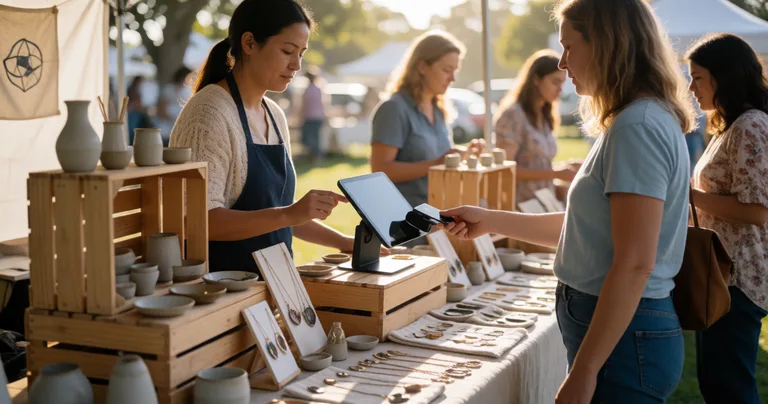
An arts and crafts POS is more than a card reader. It's the system that records every sale, tracks stock across unique items, prints or emails receipts, and tells you what actually sold on the day. For makers, that data is gold — it shapes what you make next.
The reality for most Australian stallholders is fragmented: a card terminal from one provider, a cash tin, a notebook for custom orders, and a spreadsheet at home. That's four systems doing the job of one. An integrated arts and crafts POS replaces the lot.
Evntle POS is built exactly for this. It runs on your phone, tablet or desktop, accepts cash and card (including Zeller EFTPOS), supports split payments, and keeps working in offline mode when the mobile signal drops at a regional market. You can set up pre-built templates for crafts, jewellery or clothing, and add allergen badges if you sell food alongside your wares.
Before your next market, add every item to your POS with a photo. It takes an hour up front, but it means staff can find products instantly and you get accurate stock counts at the end of the day.
The core features that actually matter
- Variable pricing and custom items — for one-off pieces, commissions and made-to-order work.
- Offline mode — so a patchy signal doesn't kill your sales.
- Stock tracking — know when you're down to the last two candles.
- Split payments — cash plus card in one transaction.
- Receipts — thermal printing or digital, your choice.
- Real-time sales view — see how the day is tracking without waiting for the tally.
Why Australian Craft Stallholders Need a Dedicated Arts and Crafts POS
Australia's market scene is booming. According to the Australian Local Government Association, there are more than 600 farmers markets operating nationally, and craft fairs, makers' markets and pop-ups have grown alongside them. That's a lot of stalls, and a lot of transactions happening in the space of four or five hours.
Speed matters. Research from the Australian Retailers Association consistently shows that shoppers abandon a purchase if the queue feels too long. At a craft stall, that's a lost sale you can't recover — the customer walks to the next tent and buys a similar candle there instead.
A dedicated arts and crafts POS also solves a compliance problem. Under Australian Taxation Office rules, you need accurate records of every sale. Under Australian Consumer Law, you need to issue receipts on request. And if you're selling food, you need allergen declarations visible at the point of sale. A proper POS handles all three without you thinking about it.
"The makers who grow from hobby to business aren't the ones with the best products — they're the ones with the best systems."
— Evntle
If you're still weighing up options, our guide to choosing a market stall POS system walks through the specific questions to ask before you commit.
Arts and Crafts POS vs Traditional Retail POS: What's the Difference?
Traditional retail POS assumes fixed prices, barcoded stock and a shopfront. Arts and crafts selling is the opposite: prices vary, items are unique, and your "shopfront" is a fold-out table for six hours.
| Feature | Traditional Retail POS | Arts and Crafts POS |
|---|---|---|
| Pricing model | Fixed, barcoded | Variable, custom items, one-offs |
| Setup time | Days, with hardware install | Minutes, on phone or tablet |
| Offline capability | Often requires a fixed line | Built-in offline mode |
| Stock tracking | Bulk SKUs | Unique items, small batches |
| Portability | Counter-bound | Fully mobile |
| Storefront | Separate ecommerce build | Built-in vendor storefront |
That last row is the one most makers overlook. A retail POS records the sale and stops there. An arts and crafts POS can push the same customer to a digital storefront, so the person who bought one print at the market can buy a set of three online next month.
Evntle Vendor Storefront gives every seller a branded page at yourname.evntle.com — products, menu, reviews, contact details, and a QR code you can print on a card and hand to customers at the stall. It's the simplest way to turn a one-off market sale into a repeat customer.
You don't need a website to have a storefront. Evntle Vendor Storefront is set up in minutes and works alongside your existing social media.
How to Choose the Right Arts and Crafts POS in Australia
Ask five questions before you sign up for anything.
1. Does it work offline?
Regional markets, community halls and outdoor festivals often have weak mobile data. If your POS stops working when the signal drops, you stop selling. Offline mode is non-negotiable.
2. Can it handle custom and variable items?
If you sell commissions, made-to-order pieces or one-off artworks, you need to enter a price on the fly without breaking your reporting.
3. What are the transaction fees?
Card processing fees in Australia typically range from 1.1% to 1.9% depending on the provider and whether the transaction is tap, insert or online. Compare this against your average sale value — a 1.5% fee on a $40 sale is 60 cents, which is fine. On a $5 sale, it's a bigger bite.
4. Does it connect to a storefront?
Your POS should feed directly into an online store so you're not manually re-listing products after every market.
5. Can you run loyalty?
Repeat customers are the lifeblood of a craft business. A POS with built-in loyalty tracking means you can reward the customer who's bought from you at four markets in a row — automatically.
For a deeper comparison of payment options, see our craft fair payments comparison guide.
Setting Up Your Arts and Crafts POS: A Step-by-Step Guide
Here's how to go from box-fresh to selling in under two hours.
- Pick your device. A tablet gives you the biggest screen for browsing products; a phone is the most portable. Evntle POS runs on both, plus desktop.
- Set up your product catalogue. Use a pre-built template for crafts, jewellery or clothing, then add photos, prices and stock counts.
- Connect your payment method. Pair a Zeller EFTPOS terminal for tap-and-go, or use the built-in card option.
- Pair your printer. A Bluetooth thermal printer gives you fast receipts without cables.
- Set up staff access. If you have helpers, give them a staff role with limited permissions — no refunds, no price changes without approval.
- Test in training mode. Run a few dummy sales so you and your team know the flow before the first customer arrives.
- Print your QR code. Hand it out with every purchase so customers can find your storefront later.
Don't rely on public Wi-Fi at a market. Even with offline mode, you'll want a mobile hotspot or a data plan as a backup for syncing at the end of the day.
Running Your Stall on Event Day: Practical Tips for Makers
Event day is where the prep pays off — or falls apart. A few habits separate the smooth stalls from the chaotic ones.
Bump-in like a pro
Arrive with a checklist. Evntle Bump-in and Bump-out lets organisers track arrivals, but vendors can use the same discipline: table, gazebo, weights, POS, printer, card reader, cash float, signage, water. Tick them off as you set up.
Manage the queue
If you sell food or drinks alongside crafts, an Order Board or Kitchen Display System keeps orders visible and customers calm. Evntle KDS sends real-time order alerts to a screen so nothing gets lost in the rush.
Capture every customer
Every sale is a chance to build a relationship. With Evntle Loyalty Program, you can log visits and spend automatically from POS orders and offer digital rewards for repeat buyers.
| Event Day Task | Manual Approach | With an Arts and Crafts POS |
|---|---|---|
| Checkout | Cash tin + card reader | Single tap-to-pay on tablet |
| Stock count | End-of-day tally by hand | Live stock levels, alerts on low items |
| Receipts | Handwritten or none | Thermal print or digital |
| Customer data | Forgotten by Monday | Logged to loyalty and storefront |
| Reporting | Spreadsheet rebuild | End-of-day summary, auto-generated |
If you want to go deeper on the operational side, our guide to best software for craft fairs in Australia covers the full stack.
Analytics and Reporting: Turning Market Sales into Smarter Decisions
The biggest advantage of a modern arts and crafts POS isn't checkout speed — it's the data you get afterwards.
Evntle Analytics & Insights gives you a live revenue dashboard, top-selling items, peak-hour heatmaps, stock alerts and end-of-day summaries. After three or four markets, patterns emerge: which products sell best in the morning, which colours move at night markets, which price points convert.
That data changes decisions. You stop guessing what to make next and start making what actually sells.
"You can't improve what you don't measure. A POS that reports properly turns every market into a learning opportunity."
— Evntle
For organisers, the same principle applies at scale. Evntle Analytics & Reporting (Organisers) tracks vendor performance, attendance and end-of-event summaries — useful when you're planning next season's stall mix.
Australian Compliance: What Arts and Crafts Sellers Need to Know
Compliance doesn't have to be complicated, but it does have to be handled.
- GST: If your turnover exceeds $75,000 per year, you must be registered for GST. Your POS should calculate and report GST automatically.
- Receipts: Under Australian Consumer Law, customers can request a receipt. Digital receipts via POS satisfy this.
- Allergens: If you sell any food or drink, allergen declarations must be available. Evntle POS supports allergen badges on item cards and order carts.
- Insurance: Most markets require public liability cover. Our event grants Australia funding guide also covers some of the support available for small operators.
Cash handling still needs to be reconciled. Evntle Staff Management includes end-of-day cash reconciliation so your records match your till.
Frequently Asked Questions
Q: What is the best arts and crafts POS for Australian stallholders?
A: The best arts and crafts POS for Australian stallholders is one that works offline, handles variable pricing for one-off items, accepts cash and card, and connects to an online storefront. Evntle POS meets all four and runs on phone, tablet or desktop.
Q: How much does an arts and crafts POS cost in Australia?
A: Costs vary. Most systems charge a monthly subscription plus card processing fees of around 1.1% to 1.9% per transaction. Evntle offers a free account registration with no credit card needed, and paid subscription plans billed monthly in advance.
Q: Can I use an arts and crafts POS without internet at a market?
A: Yes — if the POS has offline mode. Evntle POS continues to take payments and record sales when the signal drops, then syncs when you're back online. Always carry a mobile hotspot as a backup.
Q: How do I track stock for unique handmade items?
A: Add each item as its own product with a stock count of one. When it sells, it's marked as gone. For small batches, set a batch count and let the POS decrement automatically. Evntle POS supports both approaches.
Q: Do I need a separate ecommerce site to sell online?
A: No. Evntle Vendor Storefront gives you a branded page at yourname.evntle.com with products, reviews and contact details — no website build required. Hand out your QR code at the stall and customers can find you later.
Q: How do I build repeat customers from a market stall?
A: Use a POS with built-in loyalty. Evntle Loyalty Program tracks repeat customers, logs visits and spend, and offers digital rewards — all auto-tracked from POS orders.
An arts and crafts POS isn't just a faster way to take payments — it's the operating system for a maker's business. It handles the checkout, tracks the stock, captures the customer, feeds the storefront, and reports the numbers that shape what you make next. For Australian stallholders juggling markets, fairs and pop-ups, that integration is the difference between surviving event day and building something that grows. Start with a free Evntle account, set up your catalogue, and let the system do the heavy lifting so you can focus on the craft.
📖 Related
See the KDS and POS in action — try the live demo or create a free account.