
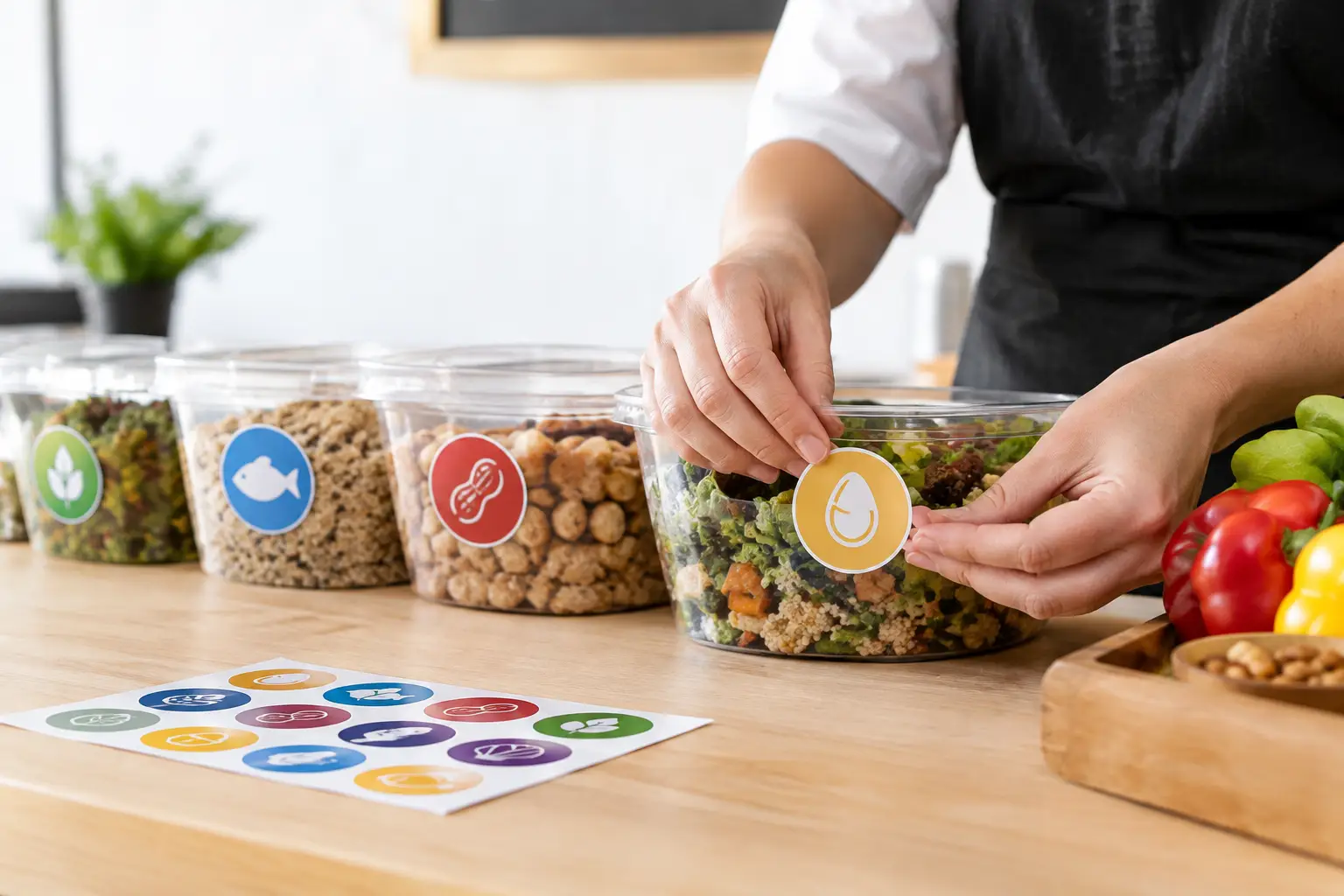
A customer at your food stall should not have to guess whether the brownie contains walnuts or whether the sauce has sesame. When you create food allergen labels that are clear, current and easy to spot, you protect customers, help your team serve with confidence and keep the queue moving when the market gets busy.
For mobile food operators, labels are not a back-office task. They are part of event-day operations, alongside stock prep, EFTPOS and signage. A good system starts before the first tent goes up and still works when you sell out of one batch, switch suppliers or bring in a casual staff member.
Start with the full ingredient picture
The fastest way to create inaccurate labels is to work from memory. Build a master record for every item you sell, including drinks, toppings, sauces, packaged grab-and-go products and samples. Record each ingredient exactly as it appears on its supplier packaging, then trace compound ingredients as well. A curry paste, spice blend, chocolate chip or mayonnaise can contain allergens that are not obvious from its name.
In Australia and New Zealand, food labelling rules require declared allergens to be presented in clear, plain English. The mandatory Plain English Allergen Labelling requirements apply to most packaged foods, but the right approach for a stall depends on what you are selling and how it is packaged. Pre-packed retail products, made-to-order meals and food served from an open display can have different obligations.
That is why your ingredient record should capture more than a simple yes or no. Note which allergens are intentionally present, where the information came from, the supplier and product version, and the date you checked it. Keep photos or copies of supplier labels where practical. If an ingredient changes, you have a clear trail for reviewing every menu label it affects.
Do not rely on a single supplier label forever
Suppliers can reformulate products, especially seasonal stock, imported products and wholesale lines. Check the label on each new delivery, not just when you first develop a recipe. If the allergen statement has changed, update your master record before that ingredient reaches service.
For a market business, this discipline prevents a common problem: the menu board says one thing, while the product in the tub or bottle says another. When in doubt, pause the item or label it conservatively until you have verified the information.
Identify the allergens in every menu item
Once your records are complete, create a simple matrix that puts each product against the allergens it contains. Australia’s declared allergen requirements cover cereals containing gluten, crustacea, egg, fish, milk, mollusc, peanut, soy, sesame and tree nuts. The specific details matter. “Nuts” is not as useful as identifying the actual tree nut where your product information allows it, and gluten-free should never be used as a shortcut for checking every other allergen.
Your matrix might show that a vegan muffin contains wheat and soy, while a dairy-free iced drink contains almond milk. It also reveals operational risks: perhaps the only sesame-containing item is a garnish added at the counter, or every fried item shares oil with a crumbed fish product.
Keep separate columns for three questions: what is in the recipe, what may be present due to the manufacturer’s advice, and what could be introduced in your own stall through cross-contact. Those are different facts and should not be treated as interchangeable.
Write labels customers can act on
The best allergen label is direct. Put the product name first, then use a consistent allergen statement that a customer can read from the front of the queue. For a packaged slice, the ingredients list and allergen declaration need to meet the applicable labelling requirements. For a made-to-order item, a clear counter sign supported by accurate staff information may be more practical.
Avoid vague wording such as “ask us about allergies” as your only communication. It is a useful invitation, but it does not tell someone whether your banana bread contains egg, milk and walnuts. Similarly, do not claim an item is “allergen-free” unless you can genuinely support that claim across ingredients, preparation and service.
Use a format your team can maintain. If allergens are highlighted in an ingredients list, use the same treatment across every packaged product. If your menu uses symbols, pair them with plain-English text and make sure the symbol key is visible. Icons can speed up scanning, but “contains sesame” is clearer than expecting customers to decode a tiny seed graphic.
Make cross-contact warnings specific
A “may contain” statement is not a catch-all disclaimer for a busy stall. Use it only when there is a real, assessed possibility of unintended allergen presence. For example, if you bake nut-free cookies in a kitchen that also handles peanuts and cannot reliably separate equipment and production, the risk needs careful communication.
On the other hand, if you can prevent cross-contact through separate utensils, labelled containers, cleaning procedures and controlled prep, build that control into your routine rather than adding blanket warnings to everything. Over-warning makes labels less useful for people trying to make an informed choice.
Build allergen controls into stall setup
Labels only work when they match what happens behind the counter. A customer may order the same safe-looking bowl each week, but a shared scoop, topping spoon or sandwich press can change the risk in seconds.
Set up your stall so that allergen handling is visible in the workflow. Keep ingredients in labelled containers, use dedicated utensils where needed and place higher-risk ingredients away from products marketed for particular dietary needs. Brief every staff member before service, including friends helping for an hour. They need to know which questions they can answer, where the current allergen sheet lives and when to escalate to the person in charge.
A practical service response is: “I’ll check the ingredient record and preparation process for you.” That is safer than a confident guess. If the information is unavailable or cross-contact cannot be assessed, say so plainly. Customers managing serious allergies generally value an honest answer over a rushed reassurance.
At larger markets, keep your allergen information available in more than one place. A concise display helps customers browse, while a detailed folder or digital record gives staff the information needed for follow-up questions. Evntle can help vendors keep event-day operations organised, but the underlying ingredient data still needs to be owned, checked and updated by the food business.
Review labels whenever the menu changes
Food stalls are flexible by nature. You may test a weekend special, substitute an ingredient after a delivery delay or add a new topping because it is selling well. Each change can affect your allergen information.
Create a quick release check before any new item goes on the menu: confirm ingredients, identify declared allergens, assess cross-contact, prepare the sign or package label, and brief the team. This takes minutes when your master ingredient record is current. It takes far longer when a customer is waiting at the counter and everyone is searching through messages for a supplier photo.
It also pays to review labels after an event. Note questions customers asked, any points where staff were unsure, and whether signage was obscured by the queue or weather. A rainy Saturday can expose whether your printed display is readable, while a sold-out lunch rush can show that your topping containers need better labels.
Know when to get specialist advice
This guide supports day-to-day stall operations, but it does not replace food law advice. Your legal responsibilities can depend on your state or territory, local council requirements, whether products are packaged, and the way food is prepared and sold. If you make claims such as gluten-free, vegan or free from a particular allergen, get advice that reflects your exact operation.
Treat allergen labelling as a live part of your menu system, not a one-time print job. When every recipe, sign and staff answer points to the same current information, customers can choose with greater confidence and your stall can serve them properly.
📖 Related
See the KDS and POS in action — try the live demo or create a free account.