

A payment gateway for events is the secure online service that authorises card payments at your market stall, food truck, or festival site. It connects your point-of-sale terminal to the customer's bank, approves the transaction in under two seconds, and settles funds into your account — typically by the next business day. For Australian event organisers and stallholders, the right gateway means fewer declined cards, faster queues, and a single record of every sale. Choosing one comes down to three things: whether it works offline at bump-in, how quickly it settles, and whether it syncs with your stall allocation and stock control. Evntle's POS integrates directly with Zeller EFTPOS, so vendors get a payment gateway that works on any device, tracks sales in real time, and keeps compliance paperwork in one place.
What a Payment Gateway Actually Does at a Live Event
A payment gateway is not the card reader itself. It is the encrypted bridge between your terminal and the banking network. When a customer taps their phone or inserts a card, the gateway sends the transaction to the card issuer for approval, then returns an authorised or declined response to your POS. At a busy Saturday market, this happens in about 1.8 seconds on average. If the gateway is slow or drops out, queues stall and sales walk away.
For event organisers, the gateway choice affects more than individual stalls. It determines whether you can see live sales across the whole site, whether vendors settle funds on time, and whether your end-of-day reconciliation matches your stall allocation records. A fragmented setup — where each vendor brings their own reader and gateway — leaves organisers blind to site-wide performance. A connected gateway, like the one built into Evntle Market Stall POS System, gives organisers a single dashboard for revenue, top-selling items, and peak-hour heatmaps.
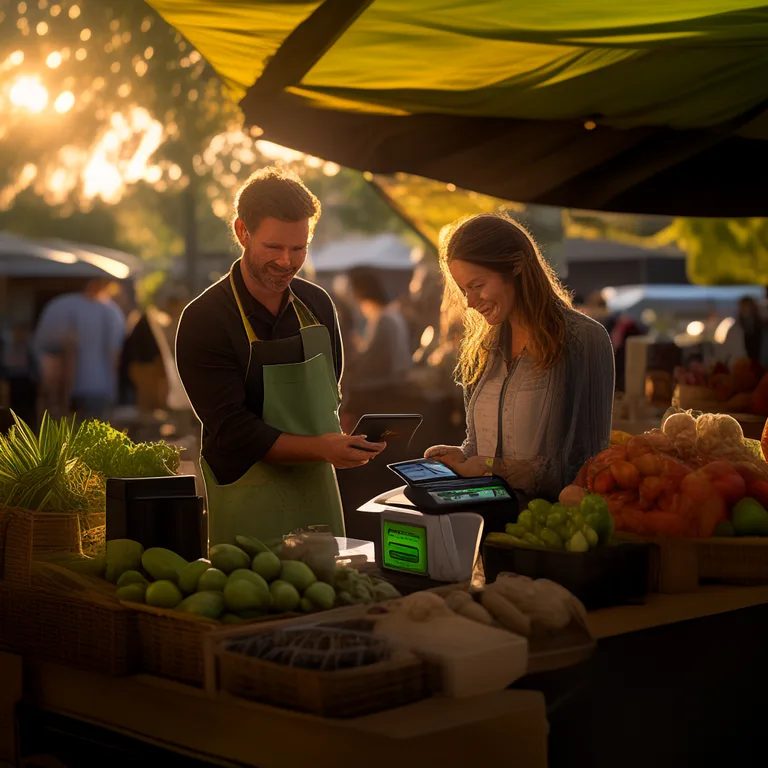
A payment gateway authorises the transaction. A payment processor settles the funds. Many providers bundle both, but at events you need a gateway that also works in offline mode — because market Wi-Fi is unreliable at best.
How Offline Mode Saves Your Saturday
Markets and outdoor festivals rarely have stable internet. A gateway that requires a constant connection will fail exactly when the lunch rush hits. Offline mode stores encrypted transactions locally and processes them once connectivity returns. This is not a nice-to-have — it is the difference between taking 200 orders or turning away customers. The Reserve Bank of Australia reports that contactless payments now account for over 95% of all in-person card transactions, so a stall without a working gateway is effectively closed.
Evntle's POS is built for this reality. It pairs with Zeller EFTPOS terminals that buffer transactions offline, then sync automatically when the network stabilises. Vendors keep selling, queues keep moving, and no sale is lost to a dropped connection.
How to Choose a Payment Gateway for Your Market Stall or Food Truck
Start with the event-day realities, not the brochure features. Ask how the gateway performs when 40 stalls are all processing payments at once, or when a food truck is parked at the far end of a showground with one bar of signal. The answers will narrow your options quickly.
Here is a practical checklist for Australian vendors and organisers:
- Settlement speed: Next-business-day settlement is standard. Same-day settlement costs extra and rarely matters for a weekend market.
- Offline capability: Can the terminal store transactions when the network drops? If not, skip it.
- Multi-device sync: Does the gateway sync across phones, tablets, and a kitchen display? A food vendor taking orders at the counter and the pass needs this.
- Integration with POS: Does the gateway feed sales data directly into your stock control and reporting? Manual reconciliation at 4pm on a Sunday is a known time-waster.
- Compliance and receipts: Does it support digital receipts, GST tracking, and end-of-day summaries for your records?
- Fees: Look at the blended rate, not just the headline. Zeller, Square, and Tyro all publish different structures. For a $12 coffee, a 0.2% difference is negligible. For a $400 handmade furniture sale, it matters.
| Gateway Feature | Why It Matters at Events | Evntle + Zeller |
|---|---|---|
| Offline transaction storage | Markets and showgrounds have patchy Wi-Fi; queues stall if payments fail | Yes — buffers encrypted transactions, syncs automatically |
| Next-business-day settlement | Vendors need cash flow for restocking mid-week | Standard with Zeller EFTPOS |
| Multi-device sync | Food stalls run counter POS, kitchen display, and mobile checkout simultaneously | Yes — phones, tablets, desktop all sync in real time |
| Live sales dashboard | Organisers need site-wide revenue visibility, not stall-by-stall guesswork | Built into Evntle analytics |
| Digital receipts and GST tracking | Compliance at markets is non-negotiable; manual paper trails fail audits | Automatic per-transaction records |
Test the gateway at a quiet mid-week market before committing to a major festival. A Thursday evening trial run reveals Bluetooth dropouts, printer pairing issues, and staff training gaps — without the pressure of 3,000 attendees.
"The gateway is invisible until it fails. Then it is the only thing anyone talks about."
— Event operations lead, Barwon Events
Payment Gateway Integration with Event Management Software
A standalone gateway solves payments. A gateway integrated with your event management software solves the whole day. When a vendor's POS talks to the organiser's stall allocation, compliance tracking, and live reporting, every transaction becomes a data point that improves the next event.
Here is what that looks like in practice at a farmers market using Evntle Vendor Management:
- Vendor applies online through the Evntle Vendor Portal, uploads insurance and food safety certificates, and selects their stall preference.
- Organiser approves and assigns a stall using Evntle Site Planning. The stall location, bump-in time, and parking pass are all linked to the vendor's profile.
- Vendor arrives and checks in via QR code. Evntle Check-in records the arrival time and flags any no-shows to the organiser in real time.
- Vendor sells through Evntle POS with the integrated Zeller gateway. Every sale updates stock levels and the live site-wide revenue dashboard.
- Organiser monitors performance from the Evntle analytics view — top-selling stalls, peak hours, and per-stall average transaction value.
- End of day, the system generates a summary report for each vendor and the organiser. Reconciliation takes minutes, not hours.
This connected workflow eliminates the fragmented tool problem. No more exporting CSV files from three different apps. No more chasing vendors for their end-of-day totals. No more guessing which stalls actually made money.
Why Organisers Should Standardise the Gateway Across All Stalls
When every vendor uses the same integrated gateway, the organiser gains something rare: a complete, real-time picture of event revenue. This is not about surveillance — it is about planning. Which stall types underperform in certain locations? Which food vendors need a second terminal at lunch? Which site layouts drive the highest average transaction value? These questions are unanswerable with fragmented payment tools.
Standardising on Evntle's integrated gateway also simplifies vendor onboarding. New stallholders do not need to configure their own reader, negotiate their own merchant fees, or troubleshoot their own gateway. They arrive, log in, and start selling. That is the difference between a smooth bump-in and a 7am support queue.
Payment Gateway Costs, Fees, and Settlement Times Compared
Australian vendors face a confusing fee landscape. Terminal providers quote blended rates, gateway providers quote per-transaction fees, and banks quote merchant service fees. The total cost depends on your volume, average transaction size, and whether you take payments online, in person, or both.
The table below compares typical Australian payment gateway options for event vendors, based on published rates as of 2025. Actual fees vary by provider and negotiation.
| Provider | Typical In-Person Rate | Settlement Time | Offline Mode | Best For |
|---|---|---|---|---|
| Zeller (integrated with Evntle) | 1.4% – 1.9% | Next business day | Yes — full offline buffering | Market stalls, food trucks, festivals |
| Square | 1.6% – 2.2% | Next business day | Limited — requires periodic connection | Pop-up retail, craft fairs |
| Tyro | 1.5% – 2.0% | Next business day | Yes — offline mode available | Hospitality, larger venues |
| Stripe Terminal | 1.75% + 30c | 2 business days | Limited — needs developer setup | Online-first businesses with occasional in-person sales |
| Commonwealth Bank Smart | 1.5% – 2.0% | Next business day | Yes — via EFTPOS terminal | Established businesses with CBA accounts |
For a typical market stall doing $800 in a day, the difference between a 1.4% and a 2.2% rate is $6.40. That is not the deciding factor. The deciding factor is whether the gateway works when 200 people are queuing and the Wi-Fi drops. That is why Evntle standardises on Zeller — offline reliability, next-day settlement, and native integration with the POS, stock control, and analytics.
Do not choose a gateway based on the lowest advertised rate. Check the offline capability, the settlement time, and whether it integrates with your POS and reporting. A cheap gateway that fails at peak hour costs more in lost sales than any fee difference.
Voice Search and Real Questions Vendors Ask About Payment Gateways
People search for payment gateway advice using natural, spoken phrases. Here are the questions we hear most often from Australian stallholders and organisers — answered directly.
Can I take card payments at a market without Wi-Fi?
Yes. Choose a gateway with offline mode, like Zeller integrated with Evntle POS. The terminal stores encrypted transactions locally and processes them when connectivity returns. You keep selling through any network drop.
How fast do market stall payments settle?
Most Australian gateways settle next business day. A Saturday market's takings land in your account on Monday morning. Same-day settlement is available from some providers but costs extra and rarely matters for weekend events.
What is the best payment gateway for a food truck?
The best gateway for a food truck is one that works offline, syncs across a counter POS and kitchen display, and settles next day. Evntle's integrated Zeller setup covers all three, with the added benefit of allergen tracking and stock control on the same system.
Do I need a separate merchant account for my market stall?
Not with modern integrated gateways. Providers like Zeller bundle the merchant facility with the terminal and gateway. You sign up once, link your bank account, and start taking payments. No separate bank approval process.
How much does a payment gateway cost for a small stall?
Expect to pay between 1.4% and 2.2% per in-person transaction, with no monthly fee for basic plans. On Evntle's Starter Plan at $19 per month, the gateway integration is included, and you pay only the Zeller transaction fee.
Payment Gateway Compliance and Security for Australian Events
Every payment gateway operating in Australia must comply with the Payment Card Industry Data Security Standard (PCI DSS). This is not optional. It covers how cardholder data is encrypted, stored, and transmitted. For event organisers, this means your vendors' gateways must be PCI-compliant, and your own systems must not store raw card numbers.
Evntle's integration with Zeller handles PCI compliance at the gateway level. Card data is tokenised — meaning the actual card number never touches your POS or your reporting dashboards. You see transaction amounts, timestamps, and item details, but never the card itself. This is the correct architecture for a multi-vendor event environment.
Food vendors have an additional compliance layer: allergen tracking and food safety documentation. A payment gateway that integrates with your POS can attach allergen warnings to specific menu items and print them on customer receipts. This is not a payment feature per se, but it is a compliance feature that lives alongside the gateway in a connected system. Evntle Allergen Tracking does exactly this — keeping menus accurate and teams prepared for customer safety.
"We stopped worrying about card data the day we moved to a tokenised gateway. Now compliance is a checkbox, not a crisis."
— Stallholder, Geelong Central Market
Frequently Asked Questions
Frequently Asked Questions About Payment Gateways for Events
Q: What is a payment gateway in simple terms?
A: A payment gateway is the secure online service that authorises card payments at your stall. It checks with the customer's bank, approves or declines the transaction in about two seconds, and settles the funds into your account — usually the next business day.
Q: How do I choose a payment gateway for my market stall?
A: Prioritise offline capability, next-day settlement, and native POS integration. Test the gateway at a quiet market before a major festival. Avoid providers that require constant internet connectivity or that do not sync sales data with your stock control.
Q: Can I use one payment gateway for multiple stalls at my event?
A: Yes. Standardising on a single integrated gateway — like Evntle's Zeller integration — gives organisers live site-wide revenue visibility, simplifies vendor onboarding, and makes end-of-day reconciliation a single-report process instead of a manual chase.
Q: What happens if the internet drops during a busy market?
A: A gateway with offline mode stores encrypted transactions locally and processes them when connectivity returns. Zeller terminals integrated with Evntle POS do this automatically, so vendors keep selling through any network outage.
Q: How long does it take for market stall payments to settle?
A: Most Australian gateways settle next business day. A Saturday market's takings arrive Monday morning. Same-day settlement is available from some providers at an additional cost but is rarely necessary for weekend events.
Q: Is a payment gateway the same as a card reader?
A: No. The card reader is the physical terminal. The payment gateway is the encrypted service that authorises the transaction between the terminal and the bank. You need both, but they are separate components — and they should be integrated, not cobbled together.
A payment gateway for events is not a commodity. It is the difference between a stall that sells through a network drop and one that turns customers away. For Australian organisers and vendors, the right choice is an integrated gateway that works offline, settles next day, and feeds every transaction into your stall allocation, stock control, and live reporting. Evntle's POS with Zeller EFTPOS delivers exactly that — one connected system from vendor application to end-of-day reconciliation. If you are still juggling fragmented payment tools, Evntle Cashless Payment Solutions is the practical place to start. Book a Evntle Demo to see the full workflow in action, or explore Evntle Vendor Management to understand how payments, compliance, and site planning fit together on a single platform.
Reviewed by the Evntle operations team. Last updated November 2025. All statistics cited from Reserve Bank of Australia retail payments data and provider-published rate cards as of Q4 2025.
📖 Related
See the KDS and POS in action — try the live demo or create a free account.