
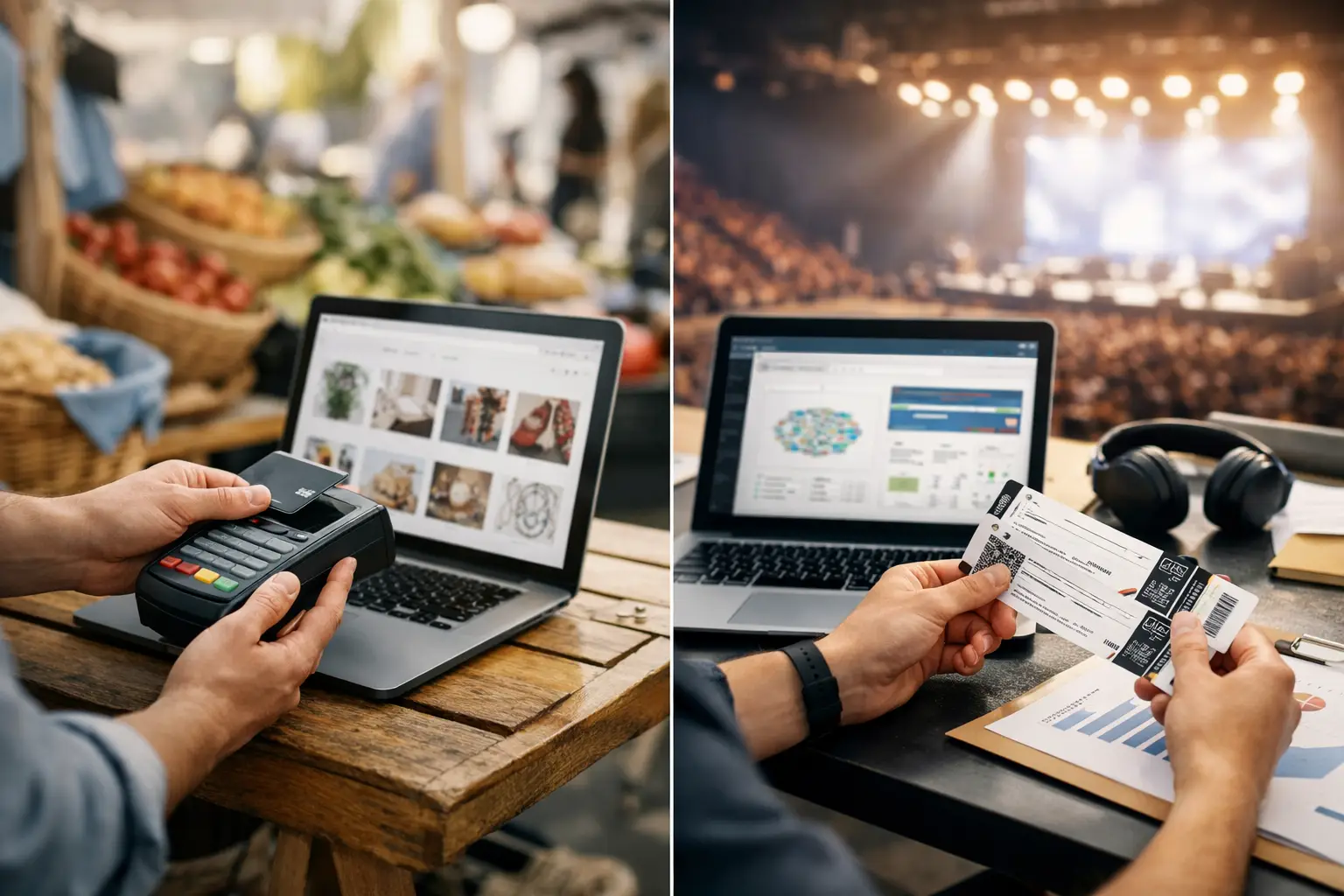
A sold-out event can still be a difficult day for organisers and vendors. Tickets may be selling well, but stallholder details are buried in spreadsheets, site changes are being handled in group chats, and attendees arrive with no idea which traders they want to visit. That is the practical difference behind vendor marketplace vs ticketing software: one manages entry, while the other can support the wider commercial life of an event.
For a small community market, a basic ticketing tool may be all you need. For a recurring farmers market, craft fair, food festival or convention with vendors who depend on sales and visibility, ticketing alone can leave major operational gaps. The right choice depends on what your event is trying to make easier for organisers, sellers and attendees.
What ticketing software is designed to do
Ticketing software has a clear job: sell and validate admission. It usually handles ticket types, promo codes, capacity limits, attendee communications, refunds and check-in. For a paid workshop, a music performance or a one-off gate-controlled event, that focus is useful.
The organiser can see how many people are expected, collect payment before the day, and scan tickets at the entrance. Attendees get a simple purchase path and proof of entry on their mobile. In this setting, a dedicated ticketing product is often fast to launch and easy to understand.
But a ticket is a record of access, not a record of event commerce. It rarely tells an attendee which vintage seller is bringing mid-century furniture, whether a food stall has sold out, or where a favourite maker is positioned on the site plan. It also does not usually give vendors a storefront, point-of-sale tools or a way to build a customer relationship after pack-down.
That distinction matters most when the people inside the gate are not just attendees. They are buyers moving between independent businesses.
What a vendor marketplace adds to the event
A vendor marketplace treats the event as a connected network rather than a single transaction at the gate. Vendors can present their business and products before the event, attendees can browse and discover who will be there, and organisers can manage the operational work that sits between applications and bump-out.
For vendors, visibility starts before event day. A stallholder can have a digital presence that helps customers find them, understand what they sell and return later. This is especially valuable for businesses that trade across multiple markets, such as mobile food operators, handmade jewellery sellers, collectables dealers and specialty retailers.
For attendees, the experience becomes more purposeful. Instead of wandering the grounds hoping to find something interesting, they can preview traders, save favourites and plan their visit. That improves discovery without taking away the enjoyment of browsing in person. A family looking for lunch, for example, can find dietary options before arriving; a collector can identify the gaming or car parts vendors worth visiting first.
For organisers, marketplace functionality can connect vendor applications, approvals, site allocation, communications, incident reporting and event-day activity. The value is not simply more features. It is less duplication between forms, spreadsheets, payment tools, maps and messages.
Vendor marketplace vs ticketing software: the key differences
The biggest difference is the unit each platform is built around. Ticketing software centres on the attendee admission transaction. Vendor marketplace software centres on the ongoing relationship between organisers, vendors and attendees.
That affects the data you can act on. A ticketing platform may show that 2,000 people entered between 10 am and midday. A marketplace platform can help show which vendors drew interest before the event, which categories attendees searched for, how vendor applications are progressing, and where operational friction is building.
It also changes how revenue opportunities are approached. Tickets are often a single purchase. Vendors, however, need the ability to make sales, capture leads, encourage repeat visits and remain discoverable after the event. If your event is free entry, ticketing may contribute little at all, while vendor discovery and on-site selling are central to the model.
Neither approach is automatically better. A 100-seat comedy night does not need a vendor ecosystem. A weekend market with 80 traders, rotating stalls and a loyal local audience probably needs more than entry scanning.
Where ticketing software can fall short
Ticketing platforms are strongest when the gate is the main operational pressure point. They become less suitable when vendor coordination is the harder problem.
Consider an organiser running a monthly makers market. They need to review applications, confirm insurance details, allocate sites, manage a waitlist, send arrival instructions and respond when a vendor has a vehicle issue on the morning. After opening, vendors need to take payments, while attendees want to find particular sellers and share what they bought.
A ticketing system may sit alongside this workflow, but it does not remove it. The organiser still assembles a stack of separate tools and carries the risk of mismatched information. A late site move might need updating in a map file, an email, a vendor message and an attendee post. When the event is live, that fragmentation costs time.
There is also a growth limitation. Vendors may pay for a stall but receive little digital value beyond a confirmation email. If the platform does not help them gain customers, they may see the event as a one-day cost rather than a channel that supports their business.
Choose based on your event model
Start by looking at how your event earns money and where the work happens. If paid entry is your primary product, ticketing should be a priority. If the event’s value comes from stalls, food, retail, community discovery and repeat vendor participation, a marketplace-led system deserves closer attention.
A ticketing-first approach is likely to fit when attendance is capped, admission is paid, vendors are minimal, and the event happens once or twice a year. Think theatre-style sessions, training days, performances or tightly programmed experiences.
A vendor marketplace is better suited to events where stallholders are a core attraction, vendor turnover and applications need managing, events recur, or free entry is part of the appeal. Markets, fairs, conventions, food events and enthusiast shows often fall into this category.
Many events need both capabilities. A food festival may sell timed-entry tickets while also giving each vendor a discoverable profile, a site location and tools for on-site trade. The best setup is not about choosing the longest feature list. It is about choosing a system that reflects the way money, people and information move through your event.
Questions to ask before committing
Before adopting a platform, ask whether it supports your highest-friction workflows rather than just your most visible ones. Can vendors apply and provide the details you need without back-and-forth? Can your team build and update a site plan without creating confusion? Can attendees discover traders before they arrive? Can vendors accept sales and build repeat custom? Can everyone access the right information from the devices they already use on event day?
Also consider adoption. Independent vendors are busy, often working from a trestle table or food van with limited time between customers. A platform has to be practical on a mobile, clear for first-time users and useful enough that vendors want to keep using it. The same applies to attendees. Discovery features only work when browsing is easier than searching through social posts.
Evntle is built around this broader event commerce model, bringing vendor operations, storefronts, point-of-sale, attendee discovery and organiser workflows into one place. That makes particular sense for live events where the seller experience is inseparable from the attendee experience.
The useful decision is not whether tickets matter. They often do. It is whether your event needs a tool for getting people through the gate, or a connected operating system that helps every good stall, product and local experience get found once they are inside.
📖 Related
See the KDS and POS in action — try the live demo or create a free account.