
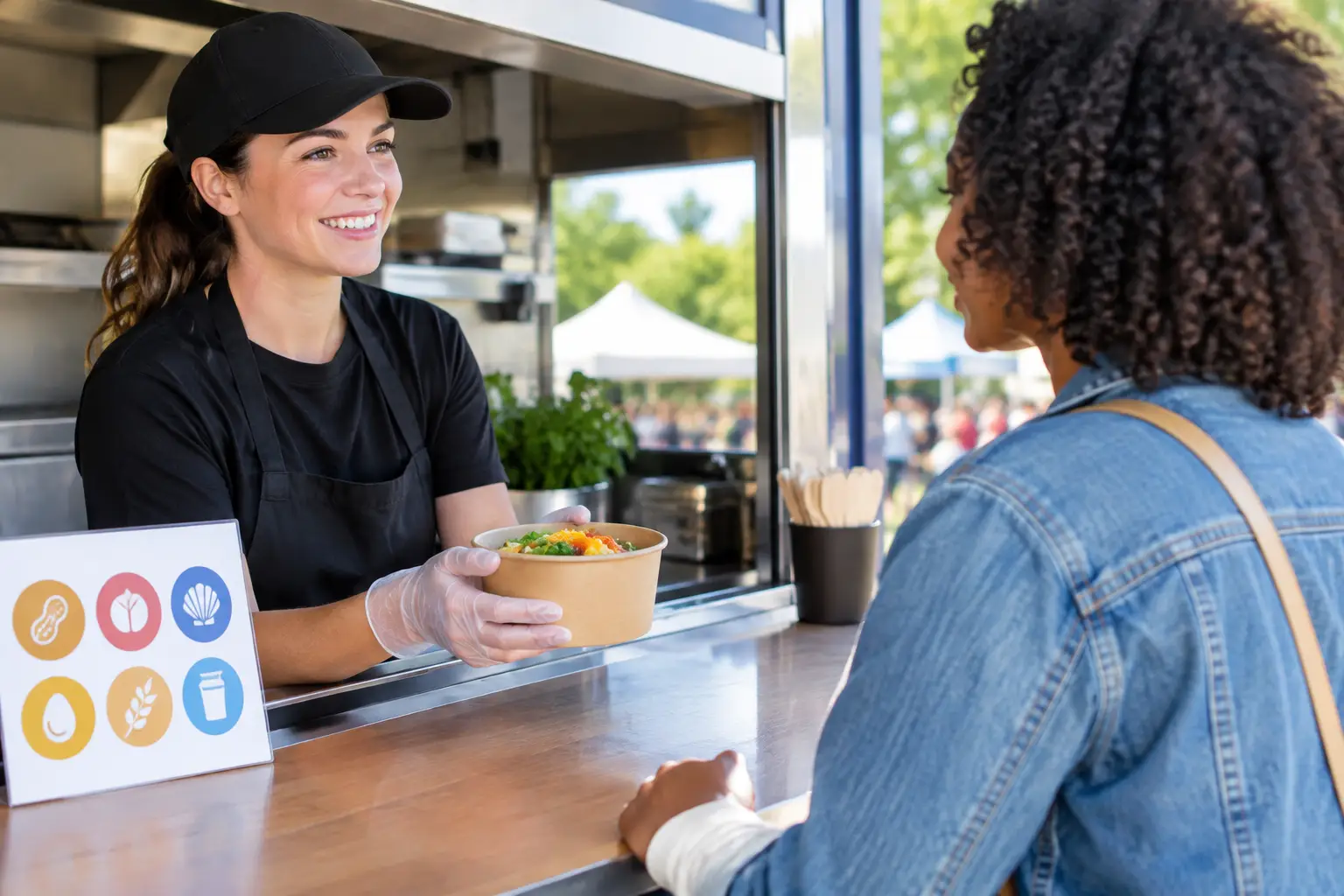
A customer tells your team they have a severe nut allergy just as the lunch queue builds. The order itself may be simple, but managing allergen orders safely is never just about taking one ingredient off a menu item. It is a full service workflow, from the first question at the counter to the final handover.
For food stalls, mobile operators and market organisers, that workflow has to work in real conditions: limited prep space, rotating casual staff, noisy queues, shared equipment and customers who may not know exactly what to ask. A clear system protects customers, gives staff confidence and helps your stall keep moving without treating allergy requests as an inconvenience.
Why allergen orders need their own workflow
An allergen request is different from a preference. A customer avoiding dairy by choice may accept a different level of risk than someone with a diagnosed allergy or coeliac disease. Your team should never guess which is which. Ask a calm, direct question: “Is this an allergy or dietary requirement we need to prepare for?” Then listen, record the answer and follow your established process.
The risk can appear at several points. An ingredient list may be incomplete, a garnish may be added automatically, tongs may have touched another product, or the person handing over the order may not realise it has been modified. The order can be entered correctly and still become unsafe through a missed handover.
That is why the best process is visible, repeatable and designed for busy trading. It does not rely on one experienced team member remembering every detail.
Managing allergen orders safely from counter to collection
Start with accurate menu information
Your team cannot communicate what it does not know. Keep an up-to-date allergen matrix for every menu item, including sauces, toppings, marinades, pre-made components and optional extras. Check supplier labels whenever stock changes, even if the product looks identical to the previous delivery.
Make the matrix easy for staff to find during service. A printed copy in the stall and a current digital version on the ordering device are both useful. The goal is not for staff to memorise every ingredient. The goal is for them to be able to verify information before making a promise to a customer.
Be precise about uncertainty. If a product is made in a shared facility, or your stall cannot prevent cross-contact because of its setup, say so plainly. It is better to lose one sale than give false reassurance. Never describe a menu item as “allergen-free” unless you can genuinely support that claim under the relevant food standards and your operating procedures.
Capture the request exactly once, then make it obvious
When an allergen request is raised, enter the specific allergen rather than a vague note such as “special order”. “No peanuts - allergy” communicates far more than “no nuts”, particularly when ingredients, sauces or oils are involved.
The request should remain attached to the order through every stage. Use a consistent flag in your point-of-sale workflow, a clearly marked docket, or both. The format matters less than consistency. Everyone involved in preparing and handing over food must be able to see that the order needs special attention.
Avoid relying on verbal messages across a crowded stall. A shouted “nut allergy” can be missed, misheard or attached to the wrong order. Verbal confirmation is valuable, but it should support the recorded instruction, not replace it.
Pause and confirm before preparation
A short pause prevents rushed assumptions. The person preparing the item should read the order, check the allergen details and confirm what can safely be offered. If there is any doubt, stop and ask the supervisor or the person responsible for food safety.
This is where a defined escalation rule helps. For example, staff may be authorised to make straightforward modifications listed in the allergen matrix, but anything outside that information goes to the stall owner or kitchen lead. Clear boundaries are faster than uncertainty, especially during a rush.
Where your controls allow an order to be prepared safely, use clean hands, fresh gloves where appropriate, cleaned and sanitised equipment, and separate utensils or containers. In a compact trailer or market gazebo, physical separation may be limited. In that case, sequence can reduce risk: prepare the allergen-aware order before handling the relevant allergen, rather than after a run of standard orders.
Protect the order at handover
The final handover is the last safety check, not just a customer service moment. Before calling the order ready, the team member should verify the docket, the meal and any packaging label. If a receipt name or order number is used, match it carefully.
Hand the meal directly to the customer where possible and state the relevant modification: “This is the order prepared without peanut sauce.” Do not announce private medical details across a queue. Keep the wording practical and discreet.
A separate collection area can help at larger events, but it only works if staff use it consistently. An allergen-aware order sitting beside similar-looking meals creates another opportunity for a mix-up. Marking and controlled handover are often more reliable than a complicated system no one follows.
Train for the questions staff will actually hear
Good allergen training is not a once-a-year slide deck. It is a short, practical routine built into onboarding, pre-event briefings and menu changes. Staff should know where allergen information lives, who can answer difficult questions and when they must not guess.
Use real service scenarios. What should a new team member say when a customer asks whether chips are safe for someone with coeliac disease? What happens when a sauce bottle has no label? Who makes the call if a supplier substitutes an ingredient on event morning? These are the moments that reveal whether your process is usable.
Staff also need language that is helpful without overpromising. “I’ll check the allergen information before I confirm that” is a strong response. “It should be fine” is not.
For organisers, allergen safety starts before gates open. Vendor applications can ask food traders to provide current food business details, menus and allergen management information where relevant. Site plans should consider access to handwashing, waste removal, power and adequate preparation space. Those basics influence whether vendors can maintain clean, controlled service during peak periods.
Design the stall for fewer mistakes
A safer workflow often comes down to simple layout choices. Keep allergen-sensitive ingredients clearly labelled and stored away from high-use prep zones where possible. Use dedicated squeeze bottles, scoops and tongs for particular ingredients. Replace worn labels immediately, not after the event.
Cross-contact risks vary by menu. A coffee cart may need to focus on milk handling and alternative milk jugs. A burger stall may need separate utensils for gluten-free buns and careful sauce control. A bakery with open display cases faces different constraints again. There is no universal layout, but every operator should identify the points where ingredients and equipment cross paths.
Be realistic about what your setup can support. A stall with one grill, one bench and a long queue may not be able to safely accommodate every request. Honest limits, communicated early, are part of responsible service.
Build incident readiness into event operations
Even careful teams can face a near miss: the wrong sauce is added, an order is handed to the wrong customer, or a staff member spots an unclear label. The right response is immediate action, not quiet correction. Stop the order, keep it separate, notify the customer if necessary and involve the designated lead.
Organisers should make sure vendors know how to report incidents and where first aid support is located. A documented incident process helps teams capture what happened, respond appropriately and improve the workflow before the next event. It also creates a more coordinated environment when multiple food traders share one site.
After each event, review the questions that slowed service down. If customers repeatedly ask about the same ingredient, add clearer information. If staff keep missing modifiers, change the docket format or briefing routine. Small operational fixes compound over a season.
A well-run allergen process does more than reduce risk. It tells customers that your stall respects their needs, your team knows its job and your event is built for people to participate with confidence. That trust is earned one careful order at a time.
📖 Related
See the KDS and POS in action — try the live demo or create a free account.