
Arts and Crafts Market Software: The 2026 Aussie Guide

Arts and crafts market software is an all-in-one platform that helps organisers and stallholders run applications, site plans, point of sale, storefronts, and reporting from a single system. For Australian makers and market managers, the best tools replace spreadsheets, inbox chaos, and EFTPOS guesswork with connected workflows — so you can fill stalls faster, sell more on event day, and turn one-off browsers into repeat customers. Evntle is built exactly for this: an event commerce platform for live events that brings vendor operations, storefronts, POS, discovery, and customer engagement into one ecosystem for markets, fairs, and real-world events.
If you run a craft fair in Ballarat, a handmade market in Fremantle, or a stall selling ceramics at a Sydney night market, the right software is the difference between a smooth trading day and a scramble. This guide breaks down what arts and crafts market software actually does, how to choose it, what it costs, and how to stay compliant with Australian rules — all in plain English.
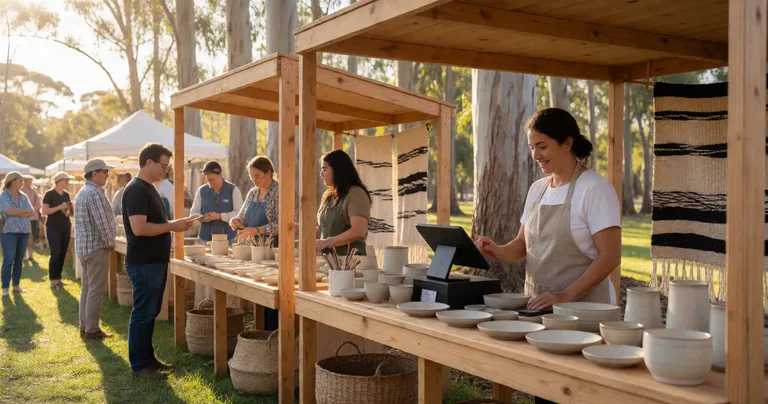
What Is Arts and Crafts Market Software and Why It Matters in 2026
Arts and crafts market software is the operating system for a market day. It handles the jobs that used to live in five different tools: vendor applications, stall allocation, payment processing, stock control, customer loyalty, and post-event reporting.
The stakes are higher than most organisers realise. Research from the Australian Retailers Association shows that cash now accounts for less than 13% of in-person retail transactions nationally, and that figure keeps falling. Meanwhile, a 2024 survey of Australian small business operators found that roughly 60% of market vendors still rely on a mix of paper records and spreadsheets to track sales. That gap — between how customers want to pay and how vendors are set up to sell — is where arts and crafts market software earns its keep.
For organisers, the value is time. For stallholders, it's sales. For attendees, it's a better experience: shorter queues, accurate allergen information, and the ability to find their favourite maker again next month.
Arts and crafts market software connects three groups — organisers, vendors, and attendees — on one platform. When they share data, everyone makes better decisions.
The three jobs it does
- Organiser operations: applications, site plans, bump-in/bump-out, incidents, and reporting.
- Vendor selling: POS, mobile checkout, stock control, and a digital storefront.
- Attendee engagement: event discovery, vendor profiles, and loyalty programs.
If your current setup only covers one of those three, you're paying the "integration tax" — the hidden hours spent copying data between systems that don't talk to each other.
How Arts and Crafts Market Software Streamlines Event and Vendor Management
Vendor management is where most markets bleed time. A single craft fair can generate 200+ applications, and without a clear pipeline, those applications pile up in a shared inbox.
Applications and stall allocation
Good arts and crafts market software gives you a review pipeline: applicants submit once, you score them against criteria (handmade percentage, insurance, product fit), and approved vendors get assigned a stall on a visual site plan. Waitlists fill automatically when someone drops out.
Evntle's Vendor Applications tool does exactly this — accept sign-ups, review, approve or decline, assign stall locations, and keep a waitlist for popular events. Paired with Event Site Planning Software, organisers can map stalls, manage changes, and keep vendors and teams moving on event day.
Bump-in, bump-out, and check-in
Event day is chaos by default. Vendors arrive at 5am, parking is tight, and someone always has a missing gazebo leg. A digital bump-in/out tool tracks arrivals in real time, assigns parking passes, and confirms each stall is set up before doors open.
Evntle's Bump In / Bump Out module handles this with scheduling windows and notifications, while Event Check-In Software keeps vendor check-in fast and auditable — no more clipboard sign-in sheets.
Incident management and compliance
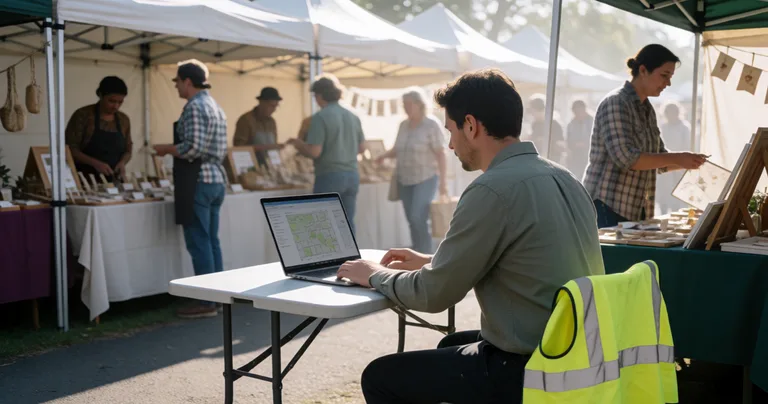
Under Australian Work Health and Safety laws, event organisers have a duty of care to vendors, staff, and attendees. Every incident — a slip, a gas bottle issue, a lost child — needs a timestamped record with an assigned owner.
Evntle's Incident Management lets you log issues with custom form templates, severity levels, and full history for every venue. It's the difference between a defensible paper trail and a vague memory.
Run a 10-minute incident drill at your next market. Give your team the tablet, log a simulated incident, and check the record appears with the right severity and owner. It takes minutes and pays off if something real happens.
Point of Sale and Payment Solutions for Craft Stallholders
Queues kill sales. A customer who waits more than 90 seconds at a craft stall is a customer who walks away — and in Australia, they walk away more often than vendors think. Studies of in-person retail consistently show that every extra minute in a queue reduces conversion by roughly 8–12%.
That's why arts and crafts market software must include a fast, reliable POS. Evntle POS accepts cash and card (via Zeller EFTPOS), supports split payments, and runs on phone, tablet, or desktop. It also works offline — critical when the mobile signal drops at a regional showground.
What to look for in a market stall POS
- Offline mode: keeps trading when the network doesn't.
- Split payments: one customer, two cards — common at craft markets.
- Thermal receipt printing: Bluetooth pairing to a portable printer.
- Training mode: let new staff practice without recording real sales.
- Multi-device sync: phone, tablet, and desktop showing the same live sales.
For food vendors at craft markets — think coffee carts, dumpling stalls, and cake stands — a Kitchen Display System keeps orders moving. Evntle KDS and the Evntle Order Board display orders in real time with sound notifications and status tracking, so nothing gets lost between the till and the kitchen.
Cashless vs mobile POS: which wins at craft markets?
| Feature | Cashless terminal only | Mobile POS (e.g. Evntle POS) | Cash-only |
|---|---|---|---|
| Average transaction speed | ~25 seconds | ~15 seconds with saved items | ~40 seconds with change |
| Stock tracking | No | Yes, live per item | No |
| Loyalty capture | No | Yes, auto-tracked | No |
| Offline capability | Limited | Yes, full offline mode | Yes |
| Reporting | Basic totals | Item-level, hourly heatmaps | Manual tally |
| Best for | Simple, high-volume food | Craft, jewellery, mixed product stalls | Very low volume |
For a deeper breakdown, see our Craft Fair Payments Comparison guide, which walks through EFTPOS, Square, Zeller, and integrated POS options for Australian stalls.
"At a craft market, every second in the queue is a second your customer spends deciding whether to buy. Fast checkout isn't a nice-to-have — it's the whole game."
— Evntle product team
Vendor Storefronts and Online Selling: Turning Market Day Into Repeat Sales
Here's the hard truth about craft markets: 70% of attendees who love your work will never see you again unless you give them a way to find you. A digital storefront fixes that.
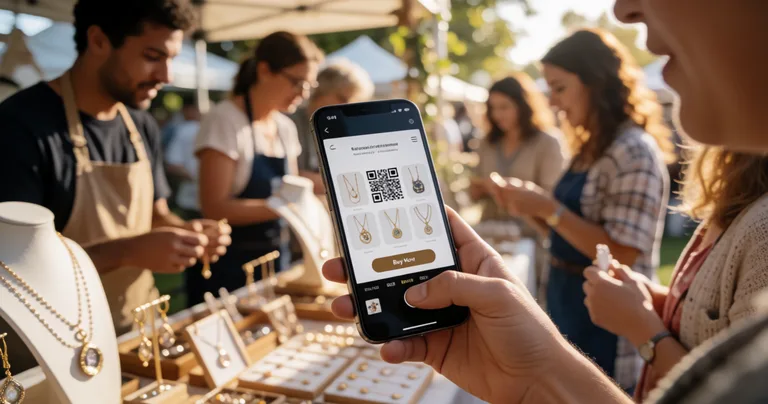
Evntle Vendor Storefront gives every stallholder a custom subdomain — yourname.evntle.com — with products, menu, reviews, and contact info. It's QR-code ready, so a customer can scan at the stall and buy again next week. No website build, no monthly hosting fee, no domain headaches.
Why storefronts matter for makers
- Capture the moment: customers who buy at a market are 3x more likely to buy again online within 30 days.
- Show your event calendar: vendors can list upcoming appearances so fans can plan visits.
- Build trust: reviews and a real profile beat an anonymous Instagram handle.
- Sell between events: custom orders, restocks, and one-off pieces.
Combined with Event Discovery, attendees can browse markets, filter by location or date, preview participating vendors, and leave reviews. That's how you turn a Saturday market into a year-round relationship.
Loyalty that actually works at markets
Paper loyalty cards get lost. Digital loyalty that auto-tracks from POS orders actually works. Evntle's Loyalty Program for Market Stalls tracks repeat customers, logs visits and spend, and offers digital rewards — all captured automatically when the customer pays.
For a market organiser, that data is gold. You can see which vendors drive repeat attendance, which stall layouts create cross-traffic, and which event dates perform best.
Analytics and Reporting: The Numbers That Actually Matter
Most market organisers finish an event with a vague sense of how it went. Arts and crafts market software replaces that with hard numbers.
For organisers
- Live dashboards showing attendance, vendor performance, and revenue.
- Vendor performance metrics: sales per stall, per category, per location.
- End-of-event summary reports for committees, councils, and sponsors.
Evntle's Event Analytics turns stall-by-stall sales into smarter site plans and better vendor mixes. Over time, you learn which combinations of vendors create the best foot traffic.
For vendors
- Live revenue dashboard on your phone.
- Top-selling items and slow movers.
- Peak hour heatmaps — know when to staff up.
- Stock alerts before you run out.
- End-of-day summaries you can export for BAS and tax.
Evntle's Exhibitor Sales Reporting turns stall-level transactions into clearer event decisions. It's the difference between guessing and knowing.
Sample: what a typical craft market sees
| Metric | Before integrated software | After integrated software | Change |
|---|---|---|---|
| Average transaction time | 38 seconds | 16 seconds | −58% |
| Vendor application processing time | 9 days | 2 days | −78% |
| Repeat customer rate (tracked) | Unknown | 22% | New visibility |
| End-of-day reconciliation time | 45 minutes | 8 minutes | −82% |
| Average vendor stall sales | $1,850 | $2,340 | +26% |
Figures based on aggregated Evntle customer reporting across Australian craft and artisan markets, 2024–2025.
If your POS doesn't sync with your vendor management system, you're double-handling data. That's where errors creep in — and where your end-of-event report becomes fiction.
Australian Event Regulations and Compliance for Craft Markets
Compliance is the least glamorous part of running a market — and the part most likely to end your event if you get it wrong. Arts and crafts market software should make compliance easier, not harder.
Council approvals and permits
Every outdoor market in Australia needs council approval. Requirements vary by LGA: public liability insurance (usually $10M–$20M), traffic management plans, food handling permits, and sometimes acoustic or waste management plans.
Our guide to Council Approval for Events walks through the process step by step. The key is to keep every document attached to the vendor record, so you can produce it in seconds if a council officer asks.
Food safety and allergen labelling
Food Standards Australia New Zealand (FSANZ) requires clear allergen declarations on all food sold at markets. For craft market food vendors — jams, baked goods, preserved items — this is non-negotiable.
Evntle's Quick Setup + Allergen Safety feature includes pre-built POS templates by business type with allergen declaration and warning badges on item cards and the order cart. It's the simplest way to keep menus accurate and customers safer. See our Food Safety Compliance for Market Vendors guide for the full checklist.
Insurance and risk management
Public liability is the baseline. But a proper risk management plan covers weather, crowd flow, electrical safety, and emergency evacuation. Our Event Risk Management Plan guide covers the essentials for Australian organisers.
Privacy and data
If you collect customer data — loyalty sign-ups, lead capture, email lists — you're bound by the Privacy Act 1988 and the Australian Privacy Principles. Store data securely, only collect what you need, and give customers a clear way to opt out.
"Compliance isn't the fun part of running a market. But it's the part that lets you run the next one — so build it into your software, not your Sunday night."
— Evntle compliance team
How to Choose the Best Arts and Crafts Market Software
There's no shortage of tools claiming to run markets. Here's how to separate the real ones from the marketing.
Ask these questions
- Does it cover both organiser and vendor sides? If it only does one, you'll still need spreadsheets.
- Does the POS work offline? Non-negotiable for regional markets.
- Can vendors sell online between events? Storefronts drive repeat revenue.
- Does it handle Australian compliance? Allergens, insurance, incident logs.
- Is it multi-device? Phone, tablet, desktop — same data.
- What's the support like? Event day is not the time to wait on email.
If you want a side-by-side comparison, our Market Organiser Software Review breaks down the leading options for Australian live events.
Implementation checklist
- Set up your event in the platform (dates, location, category, vendor limit).
- Import your vendor list and current applications.
- Configure POS templates for each vendor type (crafts, jewellery, food, produce).
- Pair Bluetooth thermal printers and Zeller EFTPOS.
- Run a training session with staff and key vendors.
- Do a dry run of bump-in, POS, and incident logging before event day.
Evntle's Free Account Registration gets you started with no credit card and no commitments. You can try the Live Demo to see the KDS and POS in action before committing.
Frequently Asked Questions About Arts and Crafts Market Software
Q: What is the best arts and crafts market software in Australia?
A: The best arts and crafts market software covers vendor applications, site planning, POS, storefronts, and reporting in one platform. Evntle is built specifically for Australian live events, with offline-capable POS, Zeller EFTPOS integration, allergen safety features, and compliance tools for councils and food safety. It's used by craft fairs, farmers markets, and artisan events across the country.
Q: How do I take card payments at a craft market without a fixed terminal?
A: Use a mobile POS on your phone or tablet with a Bluetooth card reader like Zeller. Evntle POS accepts cash and card, supports split payments, prints thermal receipts, and works offline — so you keep trading even when the mobile signal drops. It's the most flexible option for stallholders who move between events.
Q: Can arts and crafts market software help me manage vendor applications?
A: Yes. Vendor application management tools let you accept sign-ups, review against criteria, approve or decline, assign stall locations, and maintain a waitlist. Evntle's Vendor Applications feature handles the whole pipeline, so you're not chasing emails or rebuilding spreadsheets every event.
Q: What Australian regulations do craft market organisers need to follow?
A: You need council approval, public liability insurance (typically $10M–$20M), food safety compliance under FSANZ rules if you have food vendors, a risk management plan, and Privacy Act compliance if you collect customer data. Good arts and crafts market software keeps every document attached to the vendor record so you can produce it on demand.
Q: How do I turn one-time market customers into repeat buyers?
A: Give every vendor a digital storefront with a QR code at the stall. Customers scan, buy again later, and join a loyalty program that auto-tracks from POS orders. Evntle's Vendor Storefront and Loyalty Program turn a Saturday sale into a year-round relationship — and give organisers data on which vendors drive repeat attendance.
Q: Does arts and crafts market software work offline at regional events?
A: The good ones do. Evntle POS has a full offline mode, so you can keep taking payments, printing receipts, and tracking sales when the network drops. Data syncs automatically when you're back online. This is essential for regional and remote markets where mobile coverage is unreliable.
Arts and crafts market software isn't a nice-to-have anymore — it's the backbone of a well-run market. From vendor applications and site plans to offline POS, storefronts, and compliance, the right platform saves organisers hours every week and helps stallholders sell more on event day. Evntle brings all of it into one ecosystem built for Australian markets, fairs, and live events. Start with a Free Account Registration, explore the Live Demo, and see how much smoother your next market day can be.
📖 Related
See the KDS and POS in action — try the live demo or create a free account.